The Secondoldest American College College of Colonial Paper Art

Map of the 9 colonial colleges
The colonial colleges are ix institutions of higher education chartered in the Thirteen Colonies before the The states of America became a sovereign nation after the American Revolution.[1] These nine have long been considered together, notably since the survey of their origins in the 1907 The Cambridge History of English and American Literature.[2]
Seven of the 9 colonial colleges became vii of the eight Ivy League universities: Harvard, Yale, Princeton, Columbia, Academy of Pennsylvania, Brown, and Dartmouth. (The remaining Ivy League institution, Cornell University, was founded in 1865). These are all private universities.
The two colonial colleges not in the Ivy League are now both public universities — The College of William & Mary in Virginia and Rutgers University in New Jersey. William & Mary was a royal institution from 1693 until the American Revolution. Between the Revolution and the American Civil War, it was a individual institution, only it suffered pregnant damage during the Civil War and began to receive public support in the 1880s. William & Mary officially became a public college in 1906.
Rutgers was founded in 1766 as Queen's College, named for Queen Charlotte, and was for much of its history privately affiliated with the Dutch Reformed Church. It changed its name to Rutgers Academy in 1825 and was designated as the Country University of New Jersey after World State of war Ii.
The ix colonial colleges [edit]
7 of the nine colonial colleges began their histories as institutions of college learning, while two were developed past existing preparatory schools. Dartmouth College began operating in 1768 as the collegiate section of Moor's Clemency School, a secondary school started in 1754 by Dartmouth founder Eleazar Wheelock. Dartmouth considers its founding engagement to be 1769, when it was granted a collegiate charter. The University of Pennsylvania began operating in 1751 as a secondary schoolhouse, the University of Philadelphia, and added an institution of higher educational activity in 1755 with the granting of a charter to the Higher of Philadelphia.
| Image | Colonial college (present name, if different) | Colony | Founded | Chartered | Commencement instruction (degrees) | Master religious influence | Ivy League |
|---|---|---|---|---|---|---|---|
 | New College [nb 1] (Harvard University) | Massachusetts Bay Colony | 1636 | 1650[3] | 1642 (1642) | Puritan (Congregational) | Yes |
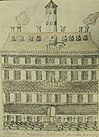 | College of William & Mary | Colony of Virginia | 1693[nb 2] | 1693[half dozen] | 1694[seven] | Church of England[nb iii] (Episcopalian) | No |
 | Collegiate Schoolhouse (Yale Academy) | Connecticut Colony | 1701 | 1701[8] | 1702 (1702 honorary MA) (1703 BA)[9] | Puritan (Congregational) | Yes |
 | College of New Jersey (Princeton University) | Province of New Bailiwick of jersey | 1746 | 1746[10] | 1747 (1748) | Presbyterian but officially nonsectarian | Aye |
 | King'due south College (Columbia University) | Province of New York | 1754 | 1754[11] | 1754 (1758) [12] | Church of England with a commitment to "religious freedom."[13] | Yes |
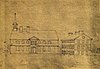 | College of Philadelphia (University of Pennsylvania) | Province of Pennsylvania | 1740 (college)[nb iv] | 1755[18] | 1755 (1757) | Church of England just officially nonsectarian[19] [nb 5] | Yes |
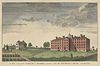 | College of Rhode Island [24] (Brown University) | Colony of Rhode Island and Providence Plantations | 1764 | 1764[25] | 1765[26] | Baptist (but no religious requirement for admissions)[nb 6] | Yeah |
 | Queen's Higher (Rutgers University) | Province of New Jersey | 1766 | 1766[28] | 1771 (1774) | Dutch Reformed (Calvinist) | No |
 | Dartmouth College | Province of New Hampshire | 1769 | 1769[29] | 1768 (1771)[nb vii] | Puritan (Congregational) | Yes |
Other colonial-era foundations [edit]
Several other colleges and universities can exist traced to colonial-era "academies" or "schools", but are not considered colonial colleges because they were not formally chartered as colleges with degree-granting powers until after the germination of the United States in 1776. Listed beneath are the founding dates of the schools which served as predecessor entities and the years in which they were chartered to operate an institution of higher learning.
| Institution (nowadays name, where dissimilar) | Colony or land | Founded | Chartered | Religious influence |
|---|---|---|---|---|
| King William'south School (absorbed by St. John'south College when the latter was founded) | Province of Maryland | 1696 | 1784 | Church building of England |
| Kent County Gratis School (absorbed by Washington Higher when the latter was founded) | Province of Maryland | 1723 | 1782 | Non-sectarian |
| Bethlehem Female Seminary (Moravian Higher) | Province of Pennsylvania | 1742 | 1863 | Moravian Church |
| Newark Academy (University of Delaware) | Delaware Colony | 1743 | 1833 | Presbyterian, merely officially non-sectarian after 1769 |
| Augusta Academy (Washington and Lee University) | Colony of Virginia | 1749 | 1782 | Presbyterian, but officially non-sectarian |
| College of Charleston | Province of Due south Carolina | 1770 | 1785 | Church building of England |
| Pittsburgh Academy (University of Pittsburgh) | Province of Pennsylvania[nb 8] | 1770?[30] | 1787 | Non-sectarian |
| Little Girls' School (Salem College) | Province of North Carolina | 1772 | 1866 | Moravian Church |
| Dickinson College | Province of Pennsylvania | 1773 | 1783 | Presbyterian |
| Hampden–Sydney Higher | Colony of Virginia | 1775 | 1783 | Presbyterian |
Encounter besides [edit]
- First university in the United States
Notes [edit]
- ^ The establishment was founded in 1636 by a vote of the legislature of the colony to provide money for "a school or higher" at Newtowne (the nowadays Cambridge). Nothing further was done most actually creating a school until 1638, when in his will John Harvard bequeathed money and books to the however-uncreated college. Construction began shortly thereafter on a school that was given the name of its outset benefactor.
- ^ The Higher of William & Mary sometimes asserts a connexion with an endeavor to institute a "University of Henrico" at Henricopolis (also known every bit Henricus) in the Colony of Virginia, which received a charter in 1618; but just a small school for Native Americans had begun operation by 1622, when the boondocks was destroyed in a Native American raid. A page on their website says "The College of William & Mary [...] was the beginning college planned for the Usa. Its roots get dorsum to the College proposed at Henrico in 1619." Nonetheless, information technology immediately proceeds to note that "The College is 2d merely to Harvard Academy in actual operation."[4] Since William & Mary describes itself as "America'due south second-oldest college" and gives its yr of founding as 1693, it does non seem to be suggesting institutional continuity with the University of Henrico, rather, Westward&M is providing historical perspective.[ original enquiry? ] All the same, this depends upon the orientation and competitiveness of the administration at whatever given time, for instance, when a Harvard grad is President, Wm & M is presented as "second college", but when Va grad is president, it is "the kickoff college in its roots"..[ original research? ] (This original college has been revived, in 1992, as "Henricus Colledge (1619), America'due south 1st College.".[5] [ failed verification ]) William & Mary has a published listing of its early graduates by its Swem Library.
- ^ In the wake of the American Ceremonious War, the College ceased to enroll students in 1882 due to attendant fiscal pressures. Students returned in 1888 later on the Commonwealth of Virginia authorized $ten,000 for it to become a state normal schoolhouse for men. In 1906 it became a public, non-sectarian school with the college's majestic charter still in upshot, except where superseded by country or federal laws.
- ^ There is some disagreement near Penn's date of founding as the academy has never used its legal charter date for this purpose and, in improver, took the unusual footstep of changing its official founding engagement approximately 150 years subsequently the fact. The commencement meeting of the founding trustees of the secondary school which somewhen became the University of Pennsylvania took place in November 1749. Secondary education for boys at the Academy of Philadelphia began in Baronial 1751. Undergraduate education for men began later a collegiate lease for the College of Philadelphia was granted in 1755. Penn initially designated 1750 every bit its founding engagement. Erstwhile later on in its early on history, Penn began to refer to 1749 instead. The schoolhouse considered 1749 to be its founding date for more than than a century until, in 1895, elite universities in the United States agreed that formal academic processions would place visiting dignitaries and other officials in the gild of their institution's founding dates. Four years subsequently in 1899, Penn'due south board of trustees voted to retroactively revise the university'southward founding engagement from 1749 to 1740 in guild to become older than Princeton, which had been chartered in 1746. The premise for this revised founding date was the fact that the University of Philadelphia purchased the building and assumed the educational mandate of an inactive trust which had originally hoped to open up a charity school for indigent children. This was part of a 1740 project that had been planned to incorporate both a church and schoolhouse though, due to insufficient funding, just the church was built and even information technology was never put into use. The dormant church edifice was conveyed to the Academy of Philadelphia in 1750.[14] [xv] [16] To further complicate the comparison of founding dates, Princeton University has historical ties to an older college. V of the twelve members of Princeton's first board of trustees were very closely associated with a "Log College" operated by Presbyterian minister William Tennent and his son Gilbert in Bucks County, Pennsylvania from 1726 until 1746.[17] Considering the College of New Jersey and the Log College shared the same religious affiliation (a moderate element inside the "New Side" or "New Calorie-free" fly of the Presbyterian Church building) and in that location was a considerable overlap in their boards of trustees, some historians suggest that there is sufficient connection between this school and the Higher of New Jersey which would enable Princeton to claim a founding date of 1726. However, Princeton does not officially do so and a academy historian says that the "facts do not warrant" such a claim.[17]
- ^ Penn'south website, similar other sources, makes an of import point of Penn'south heritage beingness nonsectarian, associated with Benjamin Franklin and the Academy of Philadelphia's nonsectarian board of trustees: "The goal of Franklin'southward nonsectarian, applied plan would be the pedagogy of a business and governing class rather than of clergymen.".[twenty] Jencks and Riesman (2001) write: "The Anglicans who founded the Academy of Pennsylvania, nonetheless, were evidently broken-hearted non to alienate Philadelphia's Quakers, and they made their new college officially nonsectarian." Franklin himself was a self-described "thorough Deist." Starting in 1751, the same trustees also operated a Clemency School for Boys, whose curriculum combined "full general principles of Christianity" with practical didactics leading toward careers in business and the "mechanical arts",[21] and thus might be described as "non-denominational Christian." The charity school was originally planned and a trust was organized on paper in 1740 by followers of traveling evangelist George Whitefield. The school was to accept operated inside a church building supported past the aforementioned group of adherents. But the organizers ran short of financing and, although the frame of the building was raised, the interior was left unfinished. The founders of the Academy of Philadelphia purchased the unused building in 1750 for their new venture and, in the process, causeless the original trust. Since 1899, Penn has claimed a founding engagement of 1740, based on the organizational date of the charity school and the premise that it had institutional identity with the University of Philadelphia. Whitefield was a firebrand Methodist associated with the Great Awakening; since the Methodists did not formally break from the Church of England until 1784, Whitefield in 1740 would be labelled Episcopalian, and in fact Brown Academy, emphasizing its own pioneering nonsectarianism, refers to Penn'south origin as "Episcopalian".[22] Penn is sometimes assumed to have Quaker ties (its athletic teams are chosen "Quakers," and the cantankerous-registration brotherhood betwixt Penn, Haverford, Swarthmore and Bryn Mawr is known as the "Quaker Consortium.") Only Penn'southward website does not assert any formal affiliation with Quakerism, historic or otherwise, and Haverford College implicitly asserts a non-Quaker origin for Penn when it states that "Founded in 1833, Haverford is the oldest establishment of higher learning with Quaker roots in North America."[23]
- ^ Brown's website characterizes it as "the Baptist answer to Congregationalist Yale and Harvard; Presbyterian Princeton; and Episcopalian Penn and Columbia," only adds that at the time it was "the but ane that welcomed students of all religious persuasions."[22] Brownish's charter stated that "into this liberal and cosmic institution shall never exist admitted any religious tests, simply on the contrary, all the members hereof shall forever savor full, gratuitous, absolute, and uninterrupted freedom of conscience." The charter farther required that its president and twenty-two of the xxx-six trustees exist Baptists, and that the remainder consist of "five Friends, four Congregationalists, and 5 Episcopalians"[27]
- ^ Dartmouth College began operating during 1768 as the collegiate department of Moor's School (1754) in Columbia, Connecticut. The collegiate department was beingness described in writing equally "Dartmouth College" past January of 1769, when the Township of Hanover, New Hampshire voted to offer it a grant of state. The institution received a royal charter on Dec 13, 1769 and its students moved from Columbia to Hanover during October 1770. The first degrees were awarded in August 1771. Queen's College, although granted a charter earlier, began performance during 1771, afterward Dartmouth College began application degrees.
- ^ Although most early records of the university were destroyed in the Great Burn down of 1845 besides every bit a subsequent burn in 1849, information technology is known that the schoolhouse began its life as a preparatory academy, perhaps as early every bit 1770,[30] or at some point in the 1780s.[31] [32] Presumably starting its life in a log cabin[33] on what was so the nation'south frontier, Hugh Henry Brackenridge sought and obtained a lease for the schoolhouse from the land legislature of the Democracy of Pennsylvania that was passed past the assembly on February 28, 1787. The school'south charter was altered in 1819 to grant it academy status and conferring on it the proper noun of the Western Academy of Pennsylvania. The university received its current name, the University of Pittsburgh, with a subsequent alteration to its lease in 1908.
References [edit]
- ^ Stoeckel, Althea (1976). "Presidents, professors, and politics: the colonial colleges and the American revolution". Conspectus of History. one (3): 45.
- ^ "XXIII. Education. § thirteen. Colonial Colleges.". The Cambridge History of English and American Literature.
- ^ "The Lease of 1650".
In witness whereof, the Courtroom hath caused the seal of the colony to be hereunto affixed. Dated the ane and thirtieth mean solar day of the 3rd month, called May, anno 1650.
May was referred to as the third month because the year began on March 25. - ^ [1] Archived February twenty, 2006, at the Wayback Auto
- ^ The College of William & Mary. "William & Mary - About". Wm.edu. Archived from the original on May 18, 2012. Retrieved Feb 19, 2012.
- ^ "Regal Charter". Swem Library Special Collections Enquiry Center Wiki. Archived from the original on May 29, 2012.
Witness our-selves, at Westminster, the eighth day of February, in the fourth year of our reign.
The first year of William III and Mary II'due south reign began on February 13, 1689 (North.Southward.). - ^ Hall, David D., Cultures of Print: Essays in the History of the Book, Univ of Massachusetts Press, 1996, p. 131
- ^ "The Yale Corporation: Charter and Legislation" (PDF). 1976.
Past the Govrn, in Council & Representatives of his Majties Colony of Connecticut in Genrll Court Assembled, New-Oasis, Octr nine: 1701
- ^ Dexter, Franklin Bowditch, Biographical Sketches of the Graduates of Yale College: with annals of the college history, Holt, 1885, Volume 1, p.vi, p.9, p.13. Nathaniel Chauncey, a Harvard BA Graduate, was awarded an honorary MA in 1702 (p. 9); John Hart was awarded an earned BA as "the first bodily student in the College" (p. xiii).
- ^ The Charters and Past-Laws of the Trustees of Princeton University. Princeton, NJ: The Princeton University Press. 1906. pp. 11–20.
A Charter to Incorporate Sundry Persons to constitute a College pass'd the Swell Seal of this Province of New Jersey ... the 22d October, 1746 ... The Charter thus mentioned has been lost ...
- ^ Charters, acts and official documents together with the lease and re-lease by Trinity church of a portion of the Male monarch'south subcontract. New York, Printed for the Higher. June 1895. pp. 10–24.
Witness our Trusty and well honey'James De Lancey, Esq., our Lieutenant Governor, and Commander in main in and over our Province of New York ... this thirty first day of October, in the year of our Lord ane k seven hundred and fifty four, and of our Reign the twenty eighth.
- ^ Johnson, Samuel, Samuel Johnson, President of King's Higher; His Career and Writings, edited past Herbert and Ballad Schneider, New York: Columbia Academy Press, 1929, Volume 4, p. 244 and p. 246 Nine students matriculated this year.
- ^ A Brief History of Columbia, Columbia University. Referenced 05.10.2011
- ^ "Table of Contents, Penn History, Academy of Pennsylvania University Athenaeum". Archives.upenn.edu. Archived from the original on February 25, 2012. Retrieved February 19, 2012.
- ^ "Gazette: Building Penn'southward Brand (Sept/October 2002)". Upenn.edu. Retrieved February 19, 2012.
- ^ "Seeley One thousand. Mudd Manuscript Library : FAQ Princeton Academy vs. Academy of Pennsylvania: Which is the older institution?". Princeton.edu. November 6, 2007. Archived from the original on March xix, 2003. Retrieved Feb nineteen, 2012.
- ^ a b "Log College". Etcweb1.princeton.edu. Archived from the original on March 4, 2016. Retrieved February 19, 2012.
- ^ Additional Charter of the Higher, &c (PDF). 1791. pp. 1–vii. Archived from the original (PDF) on March 4, 2016. Retrieved September 24, 2014.
... The Trustees of the Academy and Charitable Schoolhouse in the Province of Pennsylvania ... by these our nowadays letters and charter altered and changed ... shall be i community, corporation, and body politick, to accept continuance for ever, by the name of The Trustees of the College, Academy, and Charitable School of Philadelphia, in the Province of Pennsylvania; ... in the year of our Lord, one thousand seven hundred and fifty-five.
- ^ Jencks, Christopher; Riesman, David (2001). The Bookish Revolution. Transaction Publishers. ISBN978-0-7658-0115-9. pp. 314–5, " "The Anglicans who founded the Academy of Pennsylvania, however, were evidently anxious not to alienate Philadelphia'due south Quakers, and they made their new college officially nonsectarian."
- ^ "Overview of holdings, University Athenaeum, University of Pennsylvania University Archives". Archives.upenn.edu. Archived from the original on April 28, 2006. Retrieved Feb nineteen, 2012.
- ^ "The Charity School in the 18th century, University of Pennsylvania University Athenaeum". Athenaeum.upenn.edu. Archived from the original on June 20, 2006. Retrieved February 19, 2012.
- ^ a b "Welcome to the Office of College Admission | Undergraduate Admission". Brown University. Archived from the original on February 8, 2011. Retrieved Feb 19, 2012.
- ^ "About Haverford College". Haverford.edu. Archived from the original on February iv, 2012. Retrieved February 19, 2012.
- ^ "2 and a half centuries of history". Brown University.
Originally located in Warren, Rhode Island, and called the College of Rhode Island, Brownish moved to its current spot on College Hill overlooking Providence in 1770 and was renamed in 1804 in recognition of a $5,000 gift from Nicholas Brown, a prominent Providence man of affairs and alumnus, Class of 1786.
- ^ The Charter of Brown University (PDF). 1945. p. 30.
The next copy appears on pages 110-116 of the official records of the February Session, 1764, of the Assembly, known as the Schedules or the Acts, Resolves and Reports, which were printed at Newport by Samuel Hall and authenticated by the signature of the Secretarial assistant, Henry Ward, and the seal of the Colony, on March 12, 1764. ... Although the Charter states that information technology "shall be signed past the Governor and Secretary," this procedure was non usually required to validate an human activity of the Assembly ... Consequently, the founding of Brownish University dates from 1764 and not the time of the signature in 1765.
- ^ Hoeveler, David J., Creating the American Heed: Intellect and Politics in the Colonial Colleges, Rowman & Littlefield, 2007, p. 192
- ^ "PROVIDENCE - Online Information commodity most PROVIDENCE". Encyclopedia.jrank.org. Archived from the original on September one, 2010. Retrieved Feb 19, 2012.
- ^ Rutgers Higher: The celebration of the one hundred and fiftieth anniversary of its founding as Queens College, 1766-1916. [New Brunswick] : The College. May 1917. p. 66.
While neither the original lease of Queen's College, nor whatever copy of it, is known to exist in existence, it is known that it was granted on November ten, 1766, in the proper name of Rex George the 3rd by His Excellency William Franklin, Governor of the Province of New Jersey.
- ^ "Dartmouth College Charter".
In testimony whereof, nosotros have acquired these our messages to be made patent, and the public seal of our said province of New Hampshire to be hereunto affixed. Witness our trusty and well beloved John Wentworth, Esquire, Governor and commander-in-chief in and over our said province, [etc.], this thirteenth day of December, in the tenth year of our reign, and in the year of our Lord 1769.
- ^ a b Almanac itemize of the Western University of Pennsylvania, Yr Ending 1905. Western University of Pennsylvania. 1905. p. 27. Retrieved Dec 21, 2009.
- ^ "Early Schools". Pittsburgh School Bulletin. Pittsburgh, PA: Pittsburgh Teachers Association, Inc.: 25 May 1928. Retrieved December 22, 2009.
- ^ Kingdom of the netherlands, William Jacob (1893). First Alumni Yr Book: Our University. Pittsburgh, PA: Alumni Clan of the Western University of Pennsylvania. p. 36. Retrieved December 21, 2009.
- ^ Starrett, Agnes Lynch (1937). Through one hundred and 50 years: the University of Pittsburgh. Pittsburgh, PA: University of Pittsburgh Press. p. 26.
Source: https://en.wikipedia.org/wiki/Colonial_colleges
0 Response to "The Secondoldest American College College of Colonial Paper Art"
Post a Comment